Category Archives: Free/Libre/OpenSource Software

My jottings on FLOSS

The Times They Are A-Changin’

Or this could also be why LinuxForYou needs to pull up itself by the bootlaces and get its act together. Time is changing and changing far too rapidly for this magazine to lose focus.

On the fateful 26th (hereinafter known as The Flood), I met Alolita and Robert at the office. Sooner or later as it always happens the smalltalk veered towards LFY and how an uplift and a change of focus would be the order of the day. I had promised them that I will blog about it. Well, one month delay – but blog I did never the less.

LFY appeared at a curious crossroads. PCQ after doing a lot of good for the FLOSS (and especially Linux as an OS) space, suddenly took its focus away from FLOSS to various aspects of the enterprise stack. Additionally, both CHIP and Digit were doing the now-you-see-us and now-you-don’t trick. The momentum built up by the LUGs on the back of PCQ needed a magazine that they could talk about in their monthly meetings, distribute. More importantly, they needed a medium which was tangible enough to take home to. LFY was the perfect gift. It had articles that assumed that a lion’s share of its readers will be doing Linux for the first time. Instead of trying to be many things to many people, LFY decided to be a single thing to a demanding audience. And it worked.

Given that background, it is sad that the magazine has suddenly lost focus. It is difficult to understand why the frequent changes in positioning of the magazine, the staggered focus of its articles and most heartbreaking is the lack of content that is research based and draws some conclusion (instead of mere reporting). The one good thing about the recent issues has been the continued focus on the Enterprise Computing Space, Government and NGO deployments of FLOSS. The bad thing(s) is (are) that the content is too weak to stand up to scrutiny. It remains unstructured and there is no clear cohesiveness in a single issue. For any magazine it is a clear indication of things not going right. In case of LFY, it might be an indication to introspect and figure out what is wrong with the process. Perhaps the Editorial Team could write to the various LUGs on how best they can add value to the content of the magazine. My current wish-list (by no means complete) is as follows:

  1. More focus on application based deployments of FLOSS
  2. Study and reporting of the GoI initiatives on FLOSS
  3. Increase in the number of reprints from other magazines (LWN, LJ, Linux-Magazine
  4. Cutting down the number of regular columns (they are becoming too repititive)
  5. Getting technical articles from the various companies already engaged in FLOSS service space (I don’t mean HowTos but actual idea of various component roadmaps)
  6. Focus on custom deployments and customisation engineering
  7. Summary of the LKML threads on a monthly basis

Here’s hoping that the editorial team does take this as a request as soon as they can.
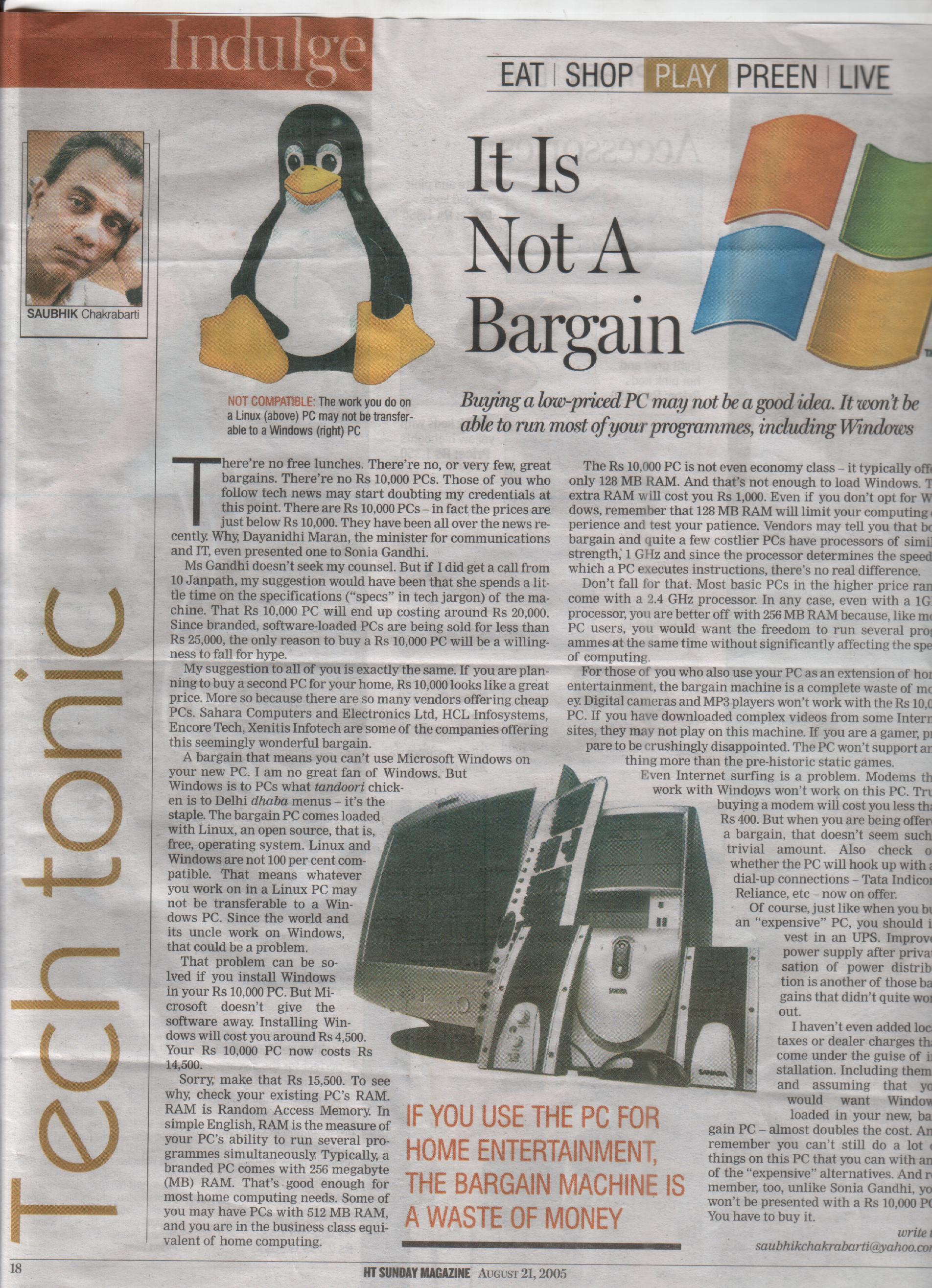
For want of a perspective the feature was lost…

The HT Magazine in a recent issue (21st August 2005) carries a column by Saubhik Chakrabarti on the recent launch of low cost PCs by some of the vendors. The uniqueness of the low cost launch has been that all these sub 10,000 INR PCs/Desktops come preloaded with Linux. Saubhik argues that it is not a bargain and that sub 10K desktops end up costing much more in terms of upkeep and usage.

The problem with the column is that it gets it wrong. Right at the beginning there is this nice blurb that the work you do on a Linux PC may not be transferable to a Windows PC. Around 2 years ago, this would have been readily agreed to. As of today, it is a trifle hard to believe. Given the large volume of desktop deployments, that particular argument will not hold water. The solution proposed is even more laughable. Install Windows on the PC.

When Acer began to ship Linux pre-loaded laptops at very affordable prices, a large volume of the sale was driven by buy the laptop-upgrade the RAM-install Windows cycle. The entire notion of providing a sub 10K PC is to provide a computing environment that is complete. It allows the desktop to be used for SOHO purposes. That means practically allowing it to perform flawlessly through the entire spectrum of office applications, media applications, internet browsing, e-mailing, IM and what not as well as some fun and games. A completely sane installation of any Linux Operating System allows one to do the same.

The column makes the same mistake again when it re-iterates that 128MB of RAM is much too less for Windows. But that is basically the point. Given the current price point of RAMs, spending another 2500 INR would provide the user with a sufficiently responsive desktop. And as the article goes on and on about how the PC will falter if one wants to use it as a home theater, one is inclined to believe that the author has not used (or perhaps even seen) a modern Linux desktop.

Buying an Alto and then analysing why it will fail to carry Qualis kinds of performance is not the right way to review either hardware or software. Perhaps Saubhik would do well to put across his functional needs for a SOHO desktop and have someone demonstrate the same on a Linux machine.

Mi primer PC…. ¡Pero de VERDAD!

Mi primer PC…. ¡Pero de VERDAD!
Even as we welcome the interest your administration has shown in developing the social program “Mi Primer PC” (My First PC, or MPPC), which aims to put computers within the reach of families with few resources, we feel that it is imperative to let you know of our objections to the terms by which this public-private initiative is being offered to the public.

On dry ground wearing dry clothes

Runa had posted about our travel in monsoon. A group of people from the Mumbai office were stuck at the beginning of the Eastern Express Highway at Sion from Tuesday (26th) 1900 hours till Wednesday (27th) till 0745. We decided to walk it out to Vikhroli (where Venky has judiciously bought a flat), had some tea and then went to respective places. That was a nearly 12km walk in belly deep water and pouring rain.

Currently, I am at Satish’s place – waiting for the time to go to office. 94.32 cms is the record rainfall in a single day eclipsing previous best of 83.43 at Cherrapunji during 1910.

By the way, this is being written using the Reliance connection which seems to be working ok.

Make your own CD

marcus.bauer at gmail dot com writes that:

Creating a customized GNOME liveCD yourself is easy and takes just a
few minutes of time:

It involves three simple steps:

1. download and unpack http://project77.info/gnomelive/liveCD-0.2.tgz
2. ./make_livecd.sh en en_US
3. burn the resulting .iso onto a CD-ROM and enjoy!

You can customise in an effortless way:

* the default language
* background images (boot splash, gnome splash, desktop)
* add sample files to the Desktop
* add and remove packages

Linux and Audio Production: Simplicity Required

Linux and Audio Production: Simplicity Required

The second issue is usability. Multi-track tools are renowned for being complex to use. This complexity is not necessarily an issue with the concept of recording audio into tracks, but the issue of having the requisite knowledge to spit shine the track with EQ, dynamics an effects to get the best out if it. This knowledge sits outside of the application. The same can be said for IDE’s – creating a project in an IDE is fairly straightforward; the challenge lies with understanding the code – an entirely separate issue.