Some of the common aspects of the texts I have stumbled across include attempts to have a model defined, description of a rudimentary framework of tasks, an analysis of infrastructure that facilitates collaboration and, a broad overview of the character of a community. Either way, I am a bit tired about “community” as a word and, I feel that it is beginning to suffer from over-use and under-statement. A primary driver for that feeling is the tendency to look at “communities” as if they were thriving specimens on a petri-dish, isolated and unperturbed in their own imaginative evolutionary cycle. That is simply untenable as a hypothesis and, impossible in real life. Communities are constituted by groups of people and, people react to the push-pull of daily life around them – the political issues, the personal issues and, the social intricacies. As much as communities try, other than a basic tenet that binds them together, there isn’t much difference between the growth of a community and, the evolution of family. The same basic principles of Belief, Responsibility, Accountability and Trust ensure that the forward momentum is not stalled.
The paradox is that having stated the above, I ended up attempting to box-in the “community” into some nice tangible parameters so as to enable explanation. Fun !
The decline of a community or, even a sub-aspect of a community can also be traced to a larger sense of hubris and, a lack of plan in terms of moving forward to embrace change. The hubris part is perhaps derived from moving away from a central core idea that was the genesis of the community and, attaining a false sense of being indestructible to external forces. Statistics are important – but statistics are external representations of symptoms – for example, wiki edits; commits to version control; activity on mailing lists; number of contributors; mass of consumers all these indicate how the community (or, tribe) is moving forward. They do not capture whether the general direction is based on the central core theme and, is moving across a wider spectrum without getting too diluted.
Why can’t “communities” be replaced by “tribes” ? Makes for a better understanding of the complexity of interaction that ensures a sustaining environment for a group of people who perceive a need to exist. And, would be able to come together to arrive at decisions that ensure sustenance. Most communities/tribes are specialized formations of people who find a common space to talk about and extend their areas of interest. As such, the need to “fabricate” a community is somewhat redundant while the need to work on providing a “commons” is important.
ps :The post is rambling in essence, at some point I’d like to re-visit this and, collate the other thoughts.
The post is brought to you by lekhonee v0.4.1
]]>There is nothing much to be said about the book from N Murthy. A collection or, more aptly, a collation of his speeches and writings these are collected around various themes. A basic point which the publishers might have considered is the selection of font and size. A book that is wholly text matter based requires a much pleasant font and comfortable spacing rather than the close-spaced result that one sees in the book. There are a few things that stand out when one reads the collection:
- his speeches tend to have repeated imagery and quotes and, a bit of sameness that becomes jarring if the book is read as a whole
- while the speeches employ rhetorical flourishes, the writings, especially in the columns of business journals have a much sharper edge and clarity
- “Be the change you want to see” is a theme oft repeated and, provided for via various examples. And, I did end up liking a number of the anecdotes.
- The sections on Values, Leadership and, various addresses to the students are worth a re-read.
All said, I had a different set of expectations from the book. Probably, that was one reason I ended up re-reading segments from Nandan Nilekani’s book. Narayan Murthy has been somewhat “up there” and, expecting a bit more insight in terms of vision isn’t asking for the moon. So, whereas Nilekani’s book does a thorough overview of a situation and digs dip down into nuts and bolts operational parts, Murthy’s writings tend to remain a bit on the “preachy” side. And, somewhat dispassionate. The book is worth reading if one has heard or, read him infrequently, else, borrow a copy to read up the section on Values. Might be worth it.
]]>I have long had the habit of averaging around 4 books a week (there have been highs of 6 books per week too). That is, reading through 4 books (mostly of different categories/genres and types) through the week. This means, that my bookshelf is a mess. And, it also means that booksellers of all kinds are very happy with me (I have a large store of dead-tree versions and, a nice long order sheet at the online stores). Around 6 months back, I figured that with rising prices of ‘books’ and, shrinking space on my shelves it is best to take a couple of steps:
- bring down the average number of books read per week from 4 to 1
- start utilizing my online bookshelves more, especially for the technical books I read
- start exploring the possibility of using netbook/mobile devices with ebook readers to get reading material
So, looking back, I see that I am currently averaging around 2 books a week. Which I like. Because, it gives me ample scope to make extensive notes about the books and their topics and provide me with thought points. On the online bookshelves part there hasn’t been much success so far other than managing to clean out most of the pending books on the Safari subscription. It is on the last that I am still pondering and, probably it would be sometime before I manage to get hold of a nice mobile device coupled with a ebook reader that allows me to read books. I just don’t intend to invest in a ebook reader hardware/software combination right now. So, no I am not looking at Kindle like devices at all. I guess my selection of Bengali literature would have seen an upswing if the ‘traditional’ Bengali publishers allowed their books to be listed on online stores.
ps: I am open to reviewing books since they allow me to indulge in my favorite luxury while getting a chance to read new stuff. So, if you know someone who’d appreciate a good reviewer, I’d be interested to get in touch.
]]>When the book finally arrived it was a mess. The package was torn, the book dog-eared and it was wet.
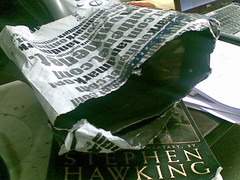

I took the above two pictures with the phone camera and put them up on flickr.
Curiously enough, on the 15th of Dec 2008, a person claiming to be heading the said bookstore/portal called up and asked for the pictures to be taken down. I requested him to write to me with the same statements that he made over phone. I await that e-mail.
I don’t really have much to say except that they just lost my business. And, I remain amazed at the notion of customer service/satisfaction that these folks have.
]]>- Began the day by reading up on Workflow Management: Models, Methods, and Systems (Cooperative Information Systems) and then somehow moved into re-reading Dreaming in Code. And, it all started because I thought of brushing up stuff before I started wrestling with YAWL. Which brings up the lazyweb question – is there a tool/application available that allows me to create workflows using YAWL ? I am not so keen on ‘coding’ the workflows.
- Random conversations led to the book Beautiful Teams. And, it looks like it would be nice to have.
- On a side note, I wonder why is it so difficult for folks to conceive of a business of printing GNU Press books on demand. It has been a long while since there have been talks about it. But nothing has moved forward.
- There is a National Conference on Free Software being held at Cochi around November 15. And, saw this off a flurry of mails on various lists.
- Current favorite picture is here. Check the rest of the photostream too.
- The paper had a snippet of an interview with V Ramesh (CEO, Prabhudas Lilladher Financial Services) who thinks that hotels can provide ‘more meeting rooms‘ to improve services because they would ‘reduce travel time to different locations’. *sigh* ! Why don’t folks talk about rationalizing the WiFi access rates in most hotels. The rates are a massive fail !!
- The paper also had an interview about the RPG Group’s foray into retail. Sanjiv Goenka talking about how the group is planning to spend around 1500 cr (that’s 7 more zeroes) INR in retail. Hmm… he hasn’t been moving about much I’d say. We happen to live close to 4 retail outlets – More (Aditya Birla), Reliance Fresh, BigBazaar (Future Group) and Spencers (RPG) and all of them provide jarring experiences. Barring BigBazaar, none of them have anything resembling parking space. Or, the walk-into-the-store area (and experience) is cramped and congested. Amongst the four, Reliance Fresh seems to have a somewhat better collection of fresh vegetables. However, the stock-out rates of stuff at Reliance is ridiculous which is where BigBazaar kind of beats all of the three hands down. There is rush at all 4 retails stores – and they don’t seem to be eating into each other’s slice of the market. But, they don’t seem to be doing well either. It would be interesting to read more about the ‘retail dream’ and ‘retail experience’ in India. The dream doesn’t seem to be going well now.