 I was reading Joerg Simon’s post on the Membership statistics and wondered if the FAmSCo has considered the following aspects:
- the load on each Ambassador Mentor ie. how many candidates are they mentoring in a specific period of time
- whether there is a need to sponsor and approve new Mentors
- whether there is a need to focus on regions from where there is a single or, no Ambassador
- the pattern, if any, in the reasons for the candidates whose applications to be a Fedora Ambassador is rejected
- whether there is a need and, a way the FAmSCo can get back in touch with such candidates and see if they can be coached to become Ambassadors (once rejected isn’t rejected forever)
I had earlier written about a few different things FAmSCo could look into. These are interesting times. The Wikipedia Ambassador/Campus Ambassador program seems to be partly based on the benefits derived from the structured workflow within the Fedora Ambassadors process. FAmSCo has an opportunity to reach out and collaborate to share knowledge about the process and at the same time incorporate suggestions which prepare the Ambassadors for higher achievements. More importantly, it would provide FAmSCo with a clearer way to measure its own success.
]]>Without further delay, here’s my wish-list for FAmSCo
- Specifically put forth a set of goals that the elected FAmSCo would work on and attach data points to it. The candidates may be had individual goals during the election phase but once elected there requires to be a cadence, a coherence. Currently, a trend I notice is an enhanced level of planning activity but not a corresponding set of performance tasks.
- Regular availability of the FAmSCo report – a cursory reading of the list archives say that this is an issue on which the ball gets dropped fairly often. The report is an invaluable way of presenting a narrative to the Fedora community at large about the functioning and changes being brought about by the FAmSCo
- Focus on regions where there aren’t enough Ambassador strength. The last time I checked there were wide swathes of the world where there aren’t enough Ambassadors yet. Reaching out to those there are and working out a step-wise plan to see how participation in and contribution to the project can be improved is a reasonably high priority item. And, solving this issue does not necessarily mean throwing money at the problem. While funds do help, at many levels it is a cop-out approach that releases one from the need to understand situations and begin conversations.
- Use the ‘slow’ time between releases a bit more judiciously. There has always been a small period of around one and a half to two months between two sets of Fedora releases when the activities within the Ambassadors communities taper down. This is partly seasonal and cyclic and partly a natural outcome of events – the initial days of a GA and, the last days that ramp up to a GA (with Regional IRC meetings etc) are the ones of hectic activity. Planning to use this window during each release to work on a set of activities that can help the Ambassadors introspect eg. Event Participation Retrospective would go a long way in making better use of time.
- Work towards converting the various FAQs into online courses/quizzes. By making them more engaging to participate in, it would probably work out better for Ambassadors who are freshly minted as well as for existing folks who need to refresh their readings. This is going to be a huge task even if it is properly scoped out. However, this will also ensure a closer collaboration within the various *SCo teams. And, potentially open up the project to a different set of contributors too.
- Organize and participate in *SCo meetings together with the Board.
- Figure out a way to get an Event Calendar similar to what LWN maintains. There has been much hand wringing and hand waving with the “wait for Fedora Insight/wait for Zarafa” coming along. The need for a calendar is driven by a very specific agenda – visibility of Fedora presence and, being able to see the proposed-vs-attended set of events. As the community grows across the globe and smaller and more often niche events require Fedora presence, the need to visually narrate the presence would create much enthusiasm.
To me a mentor is a “trusted counselor who serves as a teacher” and, mentoring or, mentorship is a personal developmental relationship in which a more experienced or more knowledgeable person helps a less experienced or less knowledgeable person (this is from the Wikipedia article which I’d recommend as a reading material).
Why would Ambassadors need a mentor anyway ? There are two answers. The simple and cop-out answer is that “everyone does”. The more complex and somewhat thought provoking answer drove the then FAmSCo folks to think through this issue. And that is because the Fedora Project puts the Ambassadors squarely in a public facing role. Over a period of time the profile of fine folks who stood up and signed-up for an Ambassador role varied. With the complexity and depth of issues that the project brings forth and, the need to always “be excellent” resonating through every activity within the project, it was a good idea to request some of the older/wiser/experienced heads to spend some time coaching the newer ranks. At no point in time was this responsibility thrust down to unwilling hands and, yet at the same time, these groups of mentors spent an inordinate amount of time ensuring that as the number of Ambassadors increased, time and effort was invested in maintaining to the high standards.
Additionally, FAmSCo has made it quite clear that it is agreeable to looking at newer mentors and, which is why there is a reasonably clear path available to any Ambassador who wishes to work with a current mentor and, thus be peer reviewed and accepted as a mentor. Having a group of one’s peers reviewing one’s performance and skills, especially soft skills is indeed a daunting experience. However, each of the newer mentors have been excellent Ambassadors and would eventually become wonderful coaches as well. In that context I somewhat like Christoph’s response. And, while the process might seem to be very “secretive” to few (it isn’t if you check the workflow), it does work because of the formal workflow that it has. Including the fact that discussions about new mentors have a section where the contributions of the Ambassador are discussed and the mentor peers provide their comments.
I don’t see a reason to keep a list of mentors-in-waiting. And, I certainly disagree with the disingenuous hint that being a ‘mentor’ is an honor or, a special title (do the mentors get a special button ? :)).
Mentoring, in my book, is a responsibility and it pleases me to see the Ambassadors who take time and make effort to coach new Ambassadors and also take time to select new mentors thus helping the project recognizing talent and appreciating contributions. Everyone can, and should, help the other person find their feet within the project and encourage contributions. Coupling this facet of a FOSS project with the idea that ‘mentor’ is a title is not only plain wrong now but wrong forever. And saying that someone who volunteers to spend time and effort to coach and help another person become a better contributor doesn’t possess any special skills (what skills are special anyway ?) is also being facile. I could draw analogies from various everyday situations at home where the “this role doesn’t require special skills” would lead to volatile situations, but you understand what I am talking about.
It is not in the special skills. It is in the special person.
]]>The current paths to obtaining Fedora media for folks in India are:
- Fedora FreeMedia Program
- Local Points of Contact
- Media produced for events
all of the above have a couple of shortcomings. So, let’s just itemize them to enable a much sweeter discussion. The underlying assumption is that we want to avoid falling into the massive media production trap – it does not return benefits. And, we would like to increase the participation at the *UG level.
- The current issue with the FreeMedia Program is scalability. It is a fashionable term, but that’s what specifically what it is. The request queue gets so overloaded that the requests need to be clamped down within 3-5 days of being opened up. And, it would be fairly obvious as to why – last mile postal charges in India are exhorbitant and, asking folks to spend their own money to take this deluge of requests is going to take some inspiring feats of oratory and, a couple of miracles. However, that is not all. The other problems are – because the FreeMedia Program gates slam down fast, at every run there would be folks who – [i] did not make their requests in time [ii] are in the queue but we have no idea of knowing whether they did get the media. So, the second part is more important – accountability. How do we make the system a bit more accountable to ensure that the requests that did make it are getting met ? And, how do we track whether, because it is “free” (as in beer), duplicate requests are not originating ?
- Local Points of Contact are a good way to off-set the huge and, somewhat human-absent nature of FreeMedia. This however is, “high touch”. And, currently has the same issues of accountability. That is, the system of tracking who-gives-whom-and-when/where is still not in place. And yet, at one level this is somewhat better. Because, the LPoC are not bound to give it away for gratis. They can charge (within bounds of reasonable practical reality) a certain sum to process the requests. In an awkward way, this could end up being very interesting for those who are diligent, disciplined and, want to make a little bit of money in the process. Money that can come in handy for things like broadband connections etc.
- Media for events are done in bulk and, sent around to the event organizers so as to enable them to distribute it. We started this off from F10 and, would be doing this for F11. This is the life-blood of events and, is not going to go away, however, this does have a danger of becoming ‘yet another goodie’ and, so we need to figure what can be done to ensure that the massive doses of media being produced and sent to events does really end up going to people who need it and, the remaining media is passed around to Ambassadors or LPoCs who know how to make best use of the system.
A couple of things come to mind so as to ensure that while we do end up meeting every request, even after discounting the ‘freeloaders’ (those who request it just because it is free), we do end up making a significant impact.
- Work out with various magazines if they want to ship Fedora media on a more regular basis. During the F10 lifecycle, we did have a significant number of media being shipped via magazines as part of their issues including spins and remixes
- Insisting that the Ambassadors put a closer ear to the ground when it comes to local LUGs. A large number of requests initiate from the *UGs and, having Ambassadors actively looking at the lists it would be easier for us to meet the requests as well as get a first level of hand-holding in place
- Making *UGs part of the LPoC cycle. In addition to individuals, providing the *UGs with the media so that they can distribute/sell/whatever does manage to take some pressure off the FreeMedia
- Work on the long road to getting more mirrors. We are not breaking much new ground this year and, that is a cause for concern. The big name institutes do need to have mirrors in place. Private mirrors, if not public. A mirror that is updated regularly does provide the focus point for the *UG within the institute and, the immediate Fedora folks outside of it to ensure that the bits are at hand to re-distribute.
- Keep on doing the “media for events” but work towards increasing the LPoC base.
So, the short summary is that we need to arrive at some protocol fast enough for us to work on:
- how to get media to those who request it
- how best to coach/guide/help those who need help to get started with Fedora
- how to bring down the number of ‘freeloaders’ in this cycle
and, in a small way, the second is ‘gated’ on the first.
]]>This is somewhat of an interesting data point. The usual trend so far has been of folks who-have-been-around the FOSS scene for a while finally deciding to formally join up as they figured out that they had been in an Ambassador role anyway. Having newer folks, especially students, is a huge upside. It allows the project and the community to reach out to groups of people who now have a peer to look up to when it comes to things Fedora. So, such things could be installation, configuration or, contributing to the project or, even trying out projects within the Fedora umbrella besides the OS itself.
Given this benefit, it is only fitting that the existing ‘old dog’ Ambassadors and the rest of the community take time out to make better FOSS citizens out of the new joinees. This means doing ‘FOSS 101’ kind of hand-holding – in person, over IRC or, via e-mail/mailing lists. This is high touch, time consuming and, somewhat of a rote job. However, if done well and, it has to be done, it will end up creating a vibrant group of people who know the tools of the trade, understand how the FOSS game is played and end up learning the basics in a much more interactive manner than ever before. In fact, the ‘they will pick up stuff along the way like we did’Â rationale of throwing the onus back would be negated.
The usual counter-argument is that this would be impossible given the number of Ambassadors and, the rate at which their tribe is increasing. I’d like to disbelieve that. No Fedora participant in India is alone. We are a fairly large group of people who can quickly band together to lend a helping hand and, so it is never a single person ending becoming a mentor for a large group. Secondly, and, this is a favorite line I (over)use – architecting a community is no different than building up a family. It takes time, it takes focus but most importantly it takes belief and trust that the basic elements of accountability and responsibility when applied would end up creating a competent, cohesive and compelling unit that others would like to emulate.
Additionally, if during the initial days, the new Ambassadors are encouraged to actively participate in any other part of the project, it should lead to greater involvement and appreciation of the Four Freedoms. This of course has the advantage of helping them build the social connects and network across projects/amongst individuals which is an invaluable part of being an Ambassador. It also builds up the required confidence in the Ambassador to go out and evangelize about contributing back to various projects and upstream. Because, if one has already drunk the Kool-Aid, talking about it is dead simple. So, for example, since most of the new folks end up organizing and leading installation fests and the like, a somewhat easier point of entry for them is QA Days. And, this is just one idea. There are many such obvious ideas being discussed and, in coming days would be slowly put to the ground.
Irrespective of when you joined the project and the community in India, keep a sharp eye on the implementation details of these plans. They are going to get things going !
]]>There will be the inevitable moaning and groaning. And, to follow a quote I heard during the ‘mail-thread-that-refuses-to-die’ : “if you have to ask whether you are inactive, aren’t you asking the obvious question ?”, this step is welcome, required and can only have upsides.
My take – I love this. Ambassadors are the front-line face of the project. And, an Ambassador can only get better because they owe it to the project. From a personal perspective, I have noted that the daily grind and administrivia leaves me with little time to catch up on events, projects, tools and what not. And, when surrounded by stars, I can get bogged down and wish for hand-holding, I can well imagine what new members or, even some of the existing old ones would be feeling. At some point in time, we all need a structured process of orientation, getting into the saddle. The sponsorship-mentorship link isn’t a gridlock. It is the dynamic combination that allows newer ideas to be shared, experiments to be repeated and, getting good things done.
I’d take this opportunity to brush up some of the stuff that has been on my WishList for long and, get more things done than I do currently. I am sure a lot of the others would too.
]]>
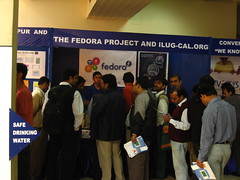
more pictures are available at the usual location. I missed out taking a group picture of the volunteers and the stall before we went into business. My bad. Noted that down as a mandatory picture for next time.
For various reasons it had been a while I have been at a stall, so the “buzz” at seeing folks lining up to hear about F10, L10n and getting their media was exciting enough. Somewhat strangely, not many questions were around the proprietary codec stuff (read: “I want to play mp3”). Having the GLUG-NIT,Durgapur (and, I met Debayan as well) at the next stall meant that we had converging streams of interested audience. It is always a good feeling to finally meeting up with a lot of names from IRC and mailing list. The F10 artwork got rave reviews
A big round of “Thank You” to all the volunteers (Gopal+his student, Dipanjan, Sarbartha, Ravi, Susmit and Indranil) who made time over the weekend to turn up, tirelessly stand around and answer questions with a big smile. A sizeable quantity of the media and leaflet/handouts were given away. Names of those interested to be on the list have been taken down and Susmit plans to get back in touch with them. Another good thing that came out was the ad-hoc sit down with the colleges who desire to have some “Activity Day”.
I had a small talk on the “Community Model” and how FOSS businesses should begin by looking at getting their act together on it. Had a couple of questions. However, given the audience profile, most questions were around FOSS software and licensing vis-a-vis “freeware”.
Would have been really nice to have network so as to show-off a few stuff – well next time perhaps. The LiveUSB station also got some love so I guess that made up for the trouble taken to set it up. The next time IOTA organizes a convention like this it would be good to have a segment for Workshops as well as an Expo area for stalls to be set up. Casting the net a bit more wider in the industry does help in getting stuff being talked about.
ps: I don’t know if the Stallman speech would be having a transcript available, but it would be good to have
pps: Was nice to know that Gopal’s student has been using Fedora since F7 and is proficient with a Linux desktop. It was obvious in the way he helped manage the stall at times.
]]>