Lovely interview. Read on.
All posts by Sankarshan Mukhopadhyay
Nice things to say
This has a very good interview with the admins of kernel.org, which makes some positive comments about using Red Hat kernels, and that Fedora is one of the more noticable ‘spikes’ in traffic they push out.
Thin slices
Read this book. Gladwell explains the concept of “thin slices” or taking snapshot instances of data and arriving at conclusions from them. The premise is simple. Most decisions can be broken down into a series of logically connected and sequential information slices. More often than not the most important part of the decision is based on the first slice which contains the information. Very pacy read and nicely constructed though on the face of it appears to be a bit hyped.
Change in contact details
In Mumbai now…and the cell # has changed. It now is +91-9820794377 and additionally I can be reached at 09323968835. The latter is a Reliance number and is more preferred.
Where is Indic L10n nowadays ?
Indic L10n is not moving. Neither forward, nor laterally. After the initial burst of energy and explosive shock of languages nothing is happening that will keep it exciting. True there has been sporadic news of community projects in languages being formed, but nothing in terms of concrete roadmap has been coming forward from these.
In a way it is a sad reflection of the state of affairs. The Indic L10n meet at HBCSE had put across a roadmap in terms of formation of a body as well as encouraging and incubating other languages. Not much has happened since then. Surprisingly enough, the existing community projects also seem to be afflicted with some sort of lethargy. The next step towards localisation of the desktop would be selecting applications to localise. Applications matter. And especially in the current scenario, applications which address the various demands of e-Governance workflow would be something that will drive forward OpenSource adoption.
Applications could include software in the domains of Content Management Systems, Workflow and Groupware suites, Collaboration Software, Management and monitoring tools. The community projects could begin to look towards such existing tools which are mature and are i18n ready to take the effort forward. Additionally, there has to be some means to get in grants for the projects. This is primarily related to developing a richer range of OpenSource fonts, dictionary and spellchecking programs. A method is also required to be found out to interact with the various government bodies which have such research projects in progress. Sharing the fruits of the labor would lead to a rapid release of the final product. And perhaps a much stronger Free/Libre OpenSource Toolkit with which to address Government initiatives.
Sometime back I had written about creation of the L10n Framework as part of the L10n roadmap for Indic languages. The need for the Framework is felt more intensely now. Creation of the Framework would allow a greater number of end-users to play with the toolsets. Such user participation would lead to innovation and feedback which will help the L10n process in the long run.
Why does this song move about in the head ?
Come gather ’round people
Wherever you roam
And admit that the waters
Around you have grown
And accept it that soon
You’ll be drenched to the bone.
If your time to you
Is worth savin’
Then you better start swimmin’
Or you’ll sink like a stone
For the times they are a-changin’.
Come writers and critics
Who prophesize with your pen
And keep your eyes wide
The chance won’t come again
And don’t speak too soon
For the wheel’s still in spin
And there’s no tellin’ who
That it’s namin’.
For the loser now
Will be later to win
For the times they are a-changin’.
Come senators, congressmen
Please heed the call
Don’t stand in the doorway
Don’t block up the hall
For he that gets hurt
Will be he who has stalled
There’s a battle outside
And it is ragin’.
It’ll soon shake your windows
And rattle your walls
For the times they are a-changin’.
Come mothers and fathers
Throughout the land
And don’t criticize
What you can’t understand
Your sons and your daughters
Are beyond your command
Your old road is
Rapidly agin’.
Please get out of the new one
If you can’t lend your hand
For the times they are a-changin’.
The line it is drawn
The curse it is cast
The slow one now
Will later be fast
As the present now
Will later be past
The order is
Rapidly fadin’.
And the first one now
Will later be last
For the times they are a-changin’.
Relocation is a pain
It is…
Especially when you are in as curious a position as mine. Too little stuff for packers and movers and too much for lugging it around oneself.
This is a real puzzle.
Missing access key in Add-Remove Packages
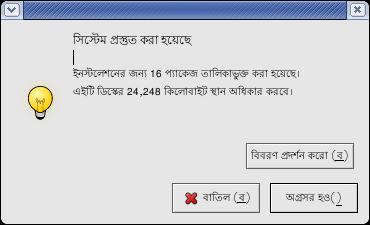
The access key is missing in one of the click through buttons.
Usage of access keys in Indic L10n
One of the aspects of Localisation (L10n) which is not being addressed very aggressively in case of Indic L10n is the issue of accelerator keys and keyboard shortcuts.
On the face of it there are two ways of addressing it:
[1] Using access keys in the local language with standard patterns for the menus
[2] Maintaining the same access keys as the English ones
Both approaches have their takers. The first one is generally adopted by nearly all the Indic L10n teams while localising the desktop environments. However, in the long run the second approach might just be something that one would require to look at seriously.
The first approach is already in place for Spanish software where Ctrl+U is the key combination for New (under the File menu) rather than Ctrl+N. This link puts forward the argument wherein the need to keep in sync with the MS-Office shortcuts are put across.
Putting in the English shortcut keys are sometimes an aberration. In the normal case, access keys are supposed to follow the natural flow of the local language. Thus, it could be easier to pick a character in the translation that is easy to remember (or perhaps following the Microsoft or MacOS guidelines). The logic being that consistency is on any day a good thing as it helps people to migrate from one platform to another. Trying to use the same access keys (as the original) makes access keys unnatural for the users of the localised distribution to remember.
In case of Indic L10n, where there is a non-latin script using latin characters as access keys would be a better option as native characters are (sometimes) more difficult to input. The way out in this case would perhaps be using the English access key in parenthesis along side the translation. This would also ensure that a consistent pattern of access keys are used by the users while they are switching between Indic locales and to English and back again.
Nautilus menu error
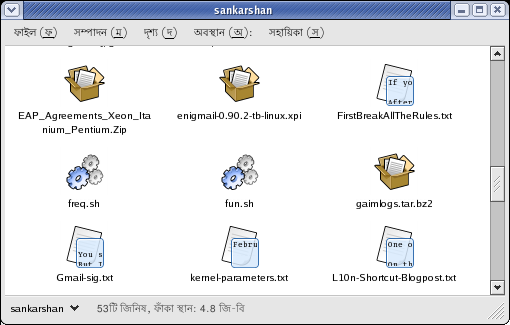
The menu item in the 2nd item from the right is oddly translated.