It is…
Especially when you are in as curious a position as mine. Too little stuff for packers and movers and too much for lugging it around oneself.
This is a real puzzle.
Missing access key in Add-Remove Packages
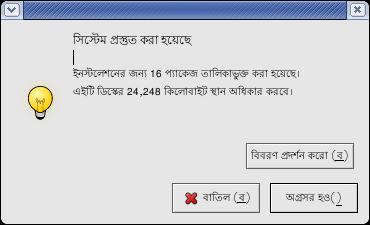
The access key is missing in one of the click through buttons.
Usage of access keys in Indic L10n
One of the aspects of Localisation (L10n) which is not being addressed very aggressively in case of Indic L10n is the issue of accelerator keys and keyboard shortcuts.
On the face of it there are two ways of addressing it:
[1] Using access keys in the local language with standard patterns for the menus
[2] Maintaining the same access keys as the English ones
Both approaches have their takers. The first one is generally adopted by nearly all the Indic L10n teams while localising the desktop environments. However, in the long run the second approach might just be something that one would require to look at seriously.
The first approach is already in place for Spanish software where Ctrl+U is the key combination for New (under the File menu) rather than Ctrl+N. This link puts forward the argument wherein the need to keep in sync with the MS-Office shortcuts are put across.
Putting in the English shortcut keys are sometimes an aberration. In the normal case, access keys are supposed to follow the natural flow of the local language. Thus, it could be easier to pick a character in the translation that is easy to remember (or perhaps following the Microsoft or MacOS guidelines). The logic being that consistency is on any day a good thing as it helps people to migrate from one platform to another. Trying to use the same access keys (as the original) makes access keys unnatural for the users of the localised distribution to remember.
In case of Indic L10n, where there is a non-latin script using latin characters as access keys would be a better option as native characters are (sometimes) more difficult to input. The way out in this case would perhaps be using the English access key in parenthesis along side the translation. This would also ensure that a consistent pattern of access keys are used by the users while they are switching between Indic locales and to English and back again.
Nautilus menu error
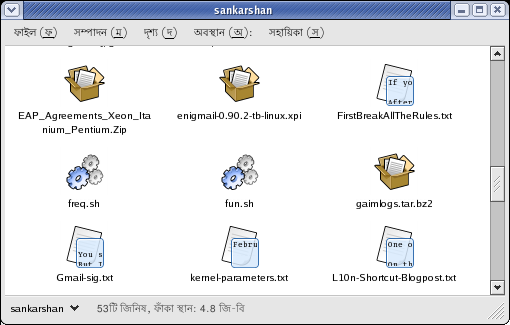
The menu item in the 2nd item from the right is oddly translated.
Should we be looking towards a Compliance Lab in India ?
FSF has a GPL Software Certification Program and Compliance Lab. To quote from the link –
The certification program provides corporations with the assurances they require when building products upon a Free Software infrastructure. When you purchase certification, FSF undertakes a comprehensive engineering and legal review of your software release to ensure that your work has been done in compliance with GPL and related Free Software licenses.
. The question is that should we begin to look at a similar function in India ?
This is an important issue when considering the various structural components of Indic L10n. More importantly, when considering the important issues of fonts and converters. My dear friend Venkatesh Hariharan often laments about the availability of good quality of fonts in the various Indian languages. Even those that are available are having unclear licensing regimes. Perhaps this is one of the reasons which prompted Soumyadip to make this post.
The Free Software Foundation has a strong presence in India, and given the stellar role it has been playing in terms of influencing policy decisions related to use of Free software in e-Governance, Education and the like, perhaps it will not be out of bounds for it to take it on. Being a proud member of the body, I am well aware as to the shortage of manpower and the sheer lack of resources. Perhaps this is the best time to address these issues.
When discussing the idea amongst a few friends, the one refrain that I heard was that this might lead to a duplication of the efforts. I think not. Prima facie it does. But if we look deeper into the matter, the members of FSF-India are very much aware and involved in the Indic L10n process. In fact, the Indic L10n community is small and tightly integrated. Thus, a preliminary validation of the licenses could be easily carried out.
An immediate benefit of such an activity might be the prevention of case where unwittingly GPL/GPL-like license violation takes place.
Umm…work to do
This week the residence was full of people from the Mumbai office. Training was scheduled for the Delhi and Kolkata teams across Saturday and Sunday and thus we had Satish, SandeepK, Palashendu and Sukanta staying over.
BDC has been here in Delhi for sometime now and one of the good things of such a thing has been that we spend some amount of time talking and walking. Have not walked in a long long time now…it is a good thing. Best part is that I get to know a lot of stuff (mostly undocumented) on the issues of the Operating System with databases, shared storage and the like. Good knowledge and a very good store of documentation.
Have a lot of books pending to be read…have to get down to the job. Additionally, the Linux Device Drivers 3rd Edition is waiting to be reviewed.
Dialog Box issues in OpenOffice.org 2 Beta
Has anyone faced similar issues ?
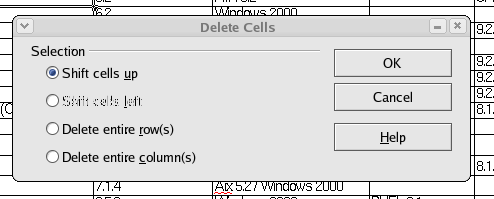
This is easily replicable across Linux and Windows platforms. I am currently using Red Hat Enterprise Linux 4
Playing around with stuff
For sometime I have been playing around with information retrieval tools with the basic requirement that creating my own APIs through extension would be easy. Another requirement is that the existing documentation should be near complete. Take a look at Xapian for those who want the same thing. Here is a sample code of the indexer. Mind you that this is highly simplified. Sometime later would start playing around with Lucene.
Current reading list includes stuff on this.
Toolkit Technology
If you ask any student passing out from the education system of West Bengal to define technology, 9 out of 10 would use definitions found in J Bronowski’s piece which is a part of the syllabus. Here is a definition that I like.
This post started from idle flipping through TV channels. I have this odd (and often annoying) habit of rapidly flipping through the channels, as a result the mishmash of images tend to form a chaotic blur. A few days back I was indulging in the same when I chanced upon some channel where Shobhaa De (I am sure there is one ‘a’ too many that I have put in !) was chatting with Sam Pitroda. At that particular moment in time the talk had veered to “Technology and India” when Sam had made an insightful observation. According to most “technology” is seen as something as elitist, glamorous and sexy. In fact in its simplest form “technology is a problem solver”. And that is exactly what it is.
In its simplest forms Information and Communication Technologies (ICTs) are problem solvers. These technologies provide the toolkits which attempt to successfully address and resolve the everyday problems. ICTs based on FLOSS are important in 2 aspects. They integrate the blue-sky vision as well as the ground level real world. Existing between these two paradigms is difficult and perhaps this is one of the reasons why FLOSS-ICT projects are more often than not addressing the grander aspects of the world vision.
First Native-Language Group Launched at OpenOffice.org
This is an important step in consolidating all the Indic Native Language Projects working in OpenOffice.org
As part of its mission, the Indic native-lang group will have to:
* coordinate localization efforts and developments
* mutualize and help the projects with the localized builds’QA.
* speed up the adoption of OpenOffice.org on a local basis and help
coordinate its promotion
* coordinate documentation writing
* communicate with the other projects of OOo and the native-lang confederation
* ease the communication between the Indic native-lang projects
This group comes as an answer for the native-lang projects to avoid the “walled garden” effect that some projects have to face, while at the mean time help these projects who lack ressources and time to develop and build themselves. Expect more groups to come in a near future. I would also like to congratulate Vijay Kumar and Rajesh Rajan for their newly appointed positions as the Group coordinators. Meanwhile, the rights and deeds of the native-lang projects’ leads remain unchanged.