We did a dash to Goa to spend the long weekend of 23rd Jan09. It was fun spending some time doing nothing while being at North Goa.

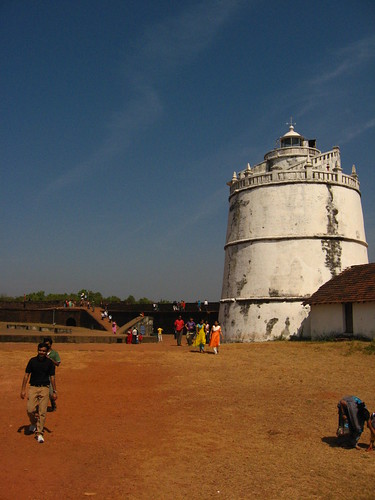
More pictures at the set.
We did a dash to Goa to spend the long weekend of 23rd Jan09. It was fun spending some time doing nothing while being at North Goa.
More pictures at the set.
I had signed up for a copy of ‘Reality Check- The Irreverent Guide to Outsmarting, Outmanaging, and Outmarketing Your Competition’ and, the book arrived nicely packed and all. Thanks to the team who took the trouble to ship it. Shipping charges to India are fairly high and, so thanks once again.
The book is “Kawasaki’s all-in-one guide for starting and operating great organizations – ones that stand the test of time and ignore any passing fads in business theory“. That is a fairly tall order, but the book does not disappoint. Direct, often blunt and cutting out the flab in sentences, Guy gets to the bottom of the story. For those who follow his blogs or, have read his earlier books, this would provide some parts of deja vu. And yet, there are new stuff in the book. It is entertaining and there are places where you just have to laugh out loud at the sheer irreverence of it all.
Good stuff around pitching (heh! that was a no-brainer), business plans (but Guy has on and off written about it), innovation, customer service and unsurprisingly schmoozing. Short crisp sentences bristling with ideas that challenge the reader to pause-think-rewind-restart and a list of clear don’ts. This is an engaging work from someone who is the ‘real deal’. Some of the content comes across as commonsense, but then, commonsense is the most uncommon commodity right now in the great game of startups.
Books in the same genre are generally cut-n-dry, full of good natured advice and suffer from a complete lack of delivering the punch line in a form that one can remember. This one doesn’t do that. And, the punchlines would be repeated over various meetings and gossip sessions. It is a thick book but it holds sway over you. In fact, it is highly recommended to have a copy handy.
From the Wikipedia entry:
In its modern usage, hubris denotes overconfident pride and arrogance; it is often associated with a lack of humility, not always with the lack of knowledge. An accusation of hubris often implies that suffering or punishment will follow, similar to the occasional pairing of hubris and nemesis in the Greek world. The proverb “pride goes before a fall” is thought to sum up the modern definition of hubris.
On Saturday, Runa and me went for a stroll around the Aga Khan Palace. It was not exactly twilight, but the gentle fade-to-dusk light from the evening sun along with the lush silence did work wonders for a bit of walking.
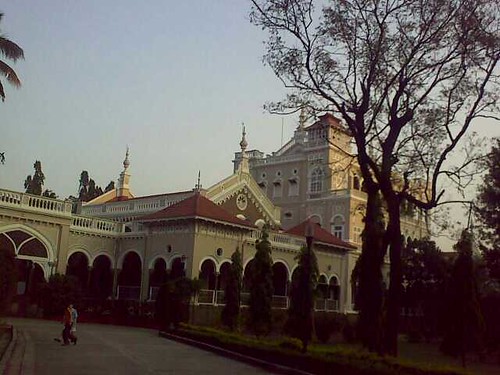
A few more photos at the usual place. And, in other news, she has updated the food blog.
Og Maciel writes about the possibility of 2009 being the Year of Translations. With the coming-out of awesome tools like Transifex, Damned Lies, Vertimus etc, it sure feels good to be even marginally involved in the process of translations.
Infrastructural pieces coming together ensure that a translation workflow that appeals to all, is easy for the end-user can be put in place with much ease. And, it would also mean a disruptive playing field for startups like Indifex. Making wide open spaces for innovation in translation workflow and infrastructure is an area that is bound to be welcomed by the folks who spend countless hours making applications, desktops and operating systems available in their local languages/locales. They don’t get appreciated often. They get recognized during release times in release notes and the like, but they do keep the engines running and the lights on. This is going to be their year.
I would venture so far as to state that in a trend of “2009 would be the Year of <insert_your_favorite_prediction>” it would be a Year of Content. Free and Open content un-encumbered by restrictive rights and legalese that would be re-distributable, would be informative, would be educational and would be able to bring about a change. Over a period of the last 24 months, methods and tools that enable content creation on Linux desktops have simplified. Especially when it comes to Indian languages. So, there are fonts available (some of them quite elegant), there are keyboard layouts, on-screen keyboards (like Indic OnScreen Keyboard or iok and even Quillpad), input methods, word-lists and like bits that form the user-experience completion when using a Linux desktop to compose content. In sort, the traditional problems in the fields of input-display-printing have been substantially addressed to bring the end-user experience at a level of where it should be easy to just plug-and-create.
There is a wealth of content in Indian languages, starting right from folk-tales that are part of the oral tradition to commercially generated content which needs to start moving into the UTF-8 encoding space. Projects like the OLPC can benefit from the availability of such forms. Work on Indic OCR remains to move forward at a much aggressive pace than what is currently, but there are signs of good things coming out of it. Digitizing data would also enable a lot of content to be archived and made available for consumption.
This is the year that should see a large part of such things happening. The marriage of content creators with the infrastructure developers is something that needs to happen as well. And, this needs to include folks from fields of comparative literature, media studies and the like. Anyone who really does generate content, should be met with and talked to regarding the need to exert themselves to become part of the process. Content already takes in a large chunk of investment outlay for the mobile players and with the availability of easy means of generating content, it would not be far to start thinking about a need to consolidate, find patterns, predict trends.
The convergence of the computing and application prowess of mobile devices, content creation workflows and upswing in the production of Indic language content for the webspace promises to make 2009 an interesting year of innovations.
Season’s Greetings to all.
I spent a day and a half at the Freedom in Computer Technology 2008 convention on 26th and 27th of this month. Susmit has already blogged about it. Some pictures are:

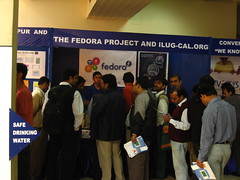
more pictures are available at the usual location. I missed out taking a group picture of the volunteers and the stall before we went into business. My bad. Noted that down as a mandatory picture for next time.
For various reasons it had been a while I have been at a stall, so the “buzz” at seeing folks lining up to hear about F10, L10n and getting their media was exciting enough. Somewhat strangely, not many questions were around the proprietary codec stuff (read: “I want to play mp3”). Having the GLUG-NIT,Durgapur (and, I met Debayan as well) at the next stall meant that we had converging streams of interested audience. It is always a good feeling to finally meeting up with a lot of names from IRC and mailing list. The F10 artwork got rave reviews 🙂
A big round of “Thank You” to all the volunteers (Gopal+his student, Dipanjan, Sarbartha, Ravi, Susmit and Indranil) who made time over the weekend to turn up, tirelessly stand around and answer questions with a big smile. A sizeable quantity of the media and leaflet/handouts were given away. Names of those interested to be on the list have been taken down and Susmit plans to get back in touch with them. Another good thing that came out was the ad-hoc sit down with the colleges who desire to have some “Activity Day”.
I had a small talk on the “Community Model” and how FOSS businesses should begin by looking at getting their act together on it. Had a couple of questions. However, given the audience profile, most questions were around FOSS software and licensing vis-a-vis “freeware”.
Would have been really nice to have network so as to show-off a few stuff – well next time perhaps. The LiveUSB station also got some love 🙂 so I guess that made up for the trouble taken to set it up. The next time IOTA organizes a convention like this it would be good to have a segment for Workshops as well as an Expo area for stalls to be set up. Casting the net a bit more wider in the industry does help in getting stuff being talked about.
ps: I don’t know if the Stallman speech would be having a transcript available, but it would be good to have
pps: Was nice to know that Gopal’s student has been using Fedora since F7 and is proficient with a Linux desktop. It was obvious in the way he helped manage the stall at times.
I just read a piece about 5000 DDA flats being allotted through lottery and recalled a snippet of conversation that I had yesterday.
It turns out that the DDA website is close to being a piece of useless web_real_estate. The current problems include
Can the powers_that_be take note of this ?
Just read off Seth’s blog that for Firefox 3.0.5, bn_IN has moved out of beta. Thanks to Runa for making that happen. The mandatory download link
Incidentally, the same post from Seth provides pointers to what would be required to be done to move a locale out from beta. That’s a good list to have handy and a page that requires to be bookmarked.
Sometime during the month of August this year, I planned to buy the two books – God Created The Integers and On The Shoulders of Giants. Since the local brick-n-mortar version of the Landmark bookstore did not have the latter, I took a chance and ordered it off the online store.
When the book finally arrived it was a mess. The package was torn, the book dog-eared and it was wet.
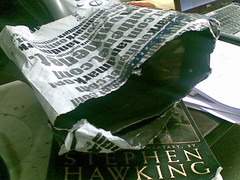
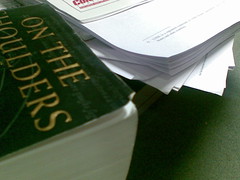
I took the above two pictures with the phone camera and put them up on flickr.
Curiously enough, on the 15th of Dec 2008, a person claiming to be heading the said bookstore/portal called up and asked for the pictures to be taken down. I requested him to write to me with the same statements that he made over phone. I await that e-mail.
I don’t really have much to say except that they just lost my business. And, I remain amazed at the notion of customer service/satisfaction that these folks have.
In an article on l10n and i18n published in this month’s edition of LinuxForYou (the article isn’t available online), Kenneth Gonsalves makes a statement as (italics are mine):
The vast majority of applications today are internationalised – the need of the hour is to provide translations in Indian languages. Except for some major applications, very little work is being done in this field. I don’t know whether it is because people are not aware of the need, are too lazy or they do not know how to!
This thought seems to be the new black. Adding on to the pre-existing notions of:
On some days I am surprised about why such perceptions prevail. If any language team/community works on
then, assuming that most projects end up following a 6 month release cycle, it leaves folks with around 3+ months (on an optimistic schedule) to work with. In fact with “string freeze” (or, the time when the developers hand off the English versions to the translators) the effective window to actually translate is around 1 month. And, I have seen that for whatever little translations I have done for GNOME and OLPC.
And, the fact that schedules are tight can be seen on the mailing lists during desktop environment release times. So, if we can assume that the teams aren’t lazy and they know what they are doing, adding any more applications to be translated (and localized) would require capacity to be added. Which means that those who do go about FOSS evangelism and FOSS advocacy have to comprehend the following:
If there are more applications that require translations/l10n, it would be a good effort to start coordinating with the language teams (via the IndLinux mailing list perhaps) rather than assuming that teams don’t know about such applications or, are lazy.