Deprecated: register_widget_control is deprecated since version 2.8.0! Use wp_register_widget_control() instead. in /home/sankarshan/sankarshan.randomink.org/blog/wp-includes/functions.php on line 4853

Deprecated: register_sidebar_widget is deprecated since version 2.8.0! Use wp_register_sidebar_widget() instead. in /home/sankarshan/sankarshan.randomink.org/blog/wp-includes/functions.php on line 4853
Random thoughts and serendipity | A collection of jottings on various issues that excite no one else | Page 5

Oh, Facebook, Facebook, thou little knowest the mischief thou hast done

The morning brought forth a micro-blog/dent from Karsten pointing out that Facebook Wants To Own Idea Of Crowdsourced Translations (read more on the link).

Embodiments of the invention provide techniques for translating text in a social network. In one embodiment translations of text phrases are received from members of the social network. These text phrases include content displayed in a social networking system, such as content from social networking objects. A particular member is provided with content including a text phrase in a first language, and the member requests translation into another language. Responsive to this request, a translation of the text phrase is selected from a set of available translations. The selection is based on actions by friends of the member in the social network, the actions being associated with the set of available translations. These actions can the viewing of or approval of translations by the friends, for example. The selected translation is then presented to the member requesting the translation.

Reading “The Art of Community”

I did reach a personal goal of bringing down the rate at which I was reading books. From around 4 books a week to 3 books a month – that’s a fair enough achievement. Among the ones I wrapped up recently, was The Art of Community (1st Edition) by Jono Bacon (linky)

I finally managed to add it to my Safari Bookshelf (for some odd reason I had to delete a book to free up a slot inspite of not being over quota) and, I did have high expectations from it, Jono has been active and visible in various communities and, I expected his enthusiasm to reflect in the writing. The book is a good one and, definitely worth a read. Interesting chapters are: Building Buzz, Measuring Community, Handling Conflict and, Hiring a Community Manager. A couple of observations about the book:

  • it draws on the shared experiences and, “stories” from various personalities and, projects making it somewhat of a “comfortable” book to read. You get to see that there are patterns to the problems across various communities and, tribes and, such patterns can be addressed
  • it isn’t “preachy” or, prescriptive or, even full of homilies. That’s a saving grace really. However, the deliberately chatty nature of the book sometimes becomes a bit too full. However, not mandating prescriptions to “fix” communities is a good thing to have in a book
  • It does have the usual attempts to define what a community manager does (including the by now cliche of “herding cats”). The end definition is somewhat more easy-on-the-ear (read the book for that :))
  • it doesn’t delve too much into the measurement aspects of the vitality of a community and, somewhat implies that the entire effort to build up and, sustain a community is somewhat of a “soft” skill issue. That, I’d say goes against the grain of the intent of the book – to demonstrate the easy of formation of communities and, the significant efforts to keep them sustained. And, although the anecdote about the 5-A-Day is insightful, on the whole, it doesn’t break new ground in statistical assessment or, deriving sense out of the number crunching
  • I’d have liked to read about examples from upstream projects like GNOME, KDE and, Mozilla. Because of the size and, nimbleness of their releases, the community experiences would have far more anecdotes about processes, tools and workflows. The book does justice in talking about the importance of having open and transparent processes, however, it doesn’t delve too deeply into the catastrophic failures that can happen if the vital emotions of Belief, Respect, Accountability and Trust are thrown to the winds. There have been ample cases in the world of Open Source where one or, all of the foundations have crumbled and, havoc ensued. Dispassionate discussion about them helps bring out the case for the need to have a vigilant community.
  • I recently read Cultivating Communities of Practice by Etienne Wenger, Richard McDermott, William M. Snyder (linky) and, expected The Art of Community to demonstrate the validity of legitimate peripheral participation in the Ubuntu community. There aren’t too many examples of those.

In short, although the books falls a bit short of my expectations, it is a good read and, a book to have on the shelf. It does not lend itself towards creating neat little check-boxes like, say, a Producing Open Source Software: How to Run a Successful Free Software Project by Karl Fogel (linky). Or, it isn’t aimed for companies who want to build a community around their products/services as is documented by Dave Neary in his blog.

On a related side note, the other books which I read and, would recommend are: 97 Things Every Project Manager Should Know, 1st Edition by Barbee Davis (linky) and, 97 Things Every Software Architect Should Know, 1st Edition by Richard Monson-Haefel (linky). Both are extremely nice read especially because they have a diverse range of inputs which make it topical. There’s a need for a 97 Things Every Community Manager Should Know as well 😉

Lastly, it would be delicious if the Safari folks allowed the bookshelf to be treated like an actual library bookshelf – check-in and, check-out books at will as opposed to waiting for a specific number of days to be able to remove the books. Oh well ! you can’t have it all I guess.

Tools of the translation trade

I begin with a caveat – I am a dilettante translator and hence the tools of my trade (these are the tools I have used in the past or, use daily) or, the steps I follow might not reflect reality or, how the “real folks” do translation. I depend to a large extent on folks doing translation-localization bits for my language and, build heavily on their works.

KBabel

I used it only infrequently when it was around in Fedora (it is still available in Red Hat Enterprise Linux 5) but once I did get over the somewhat klunky interface, it was a joy to work with. Seriously rugged and, well formed into the ways of doing translations, KBabel was the tool of choice. However, it was replaced by Lokalize (more on that later) and so, I moved on to Lokalize.

Lokalize

This has so much promise and yet, there is so much left to be desired in terms of stability. For example, a recent quirk that I noticed is that in some cases, translating the files using Lokalize and, then viewing it using a text editor shows the translated strings. However, loading them in KBabel or, another tool shows the lines as empty. The Kbabel -> Lokalize transformation within KDE could have perhaps done with a bit of structured requirements definition and, testing (I am unaware as to whether such things were actually done and, would be glad to read up any existing content on that). Then there’s this quirk for the files in the recent GNOME release – copying across the content when it is in the form Address leaves the copied form as empty space. The alternative is to input the tags again. Which is a cumbersome process. There are a number of issues reported against the Lokalize releases which actually gives me enough hope, because more issues mean more consumers and hence a need to have a stable and functional application.

Virtaal

I have used it very infrequently. The one reason for that is that it takes some time to get used to the application/tool itself. I guess sometimes too much sparseness in UI is a factor in shying away from the tool. The singular good point which merits a mention is the “Help” or, documentation in Virtaal – it is very well done and, actually demonstrates how best to use the application for day to day usage in translation. This looks to be a promising tool and, with the other parts like translation memory, terminology creator etc tagged on, it will have the makings of a strong toolchain

Pootle

I had been initially reluctant to use a web-based tool to do translations. This however might have been a factor of the early days of Pootle. With the recent Pootle releases, having a web-based translation tool is a good plus. However, it isn’t without its queer flaws – for example, it doesn’t allow one to browse to a specific phrase to translate (or, in other words, in a 290 line file, if you last left it at 175, the choices are either to traverse from the start in bunches of 10 or, 7 or, traverse from the end till one reaches the 176th line), the instances of Pootle that I have used don’t use any translation memory or, terminology add-ons to provide suggestions.

I have this evolving feeling that having a robust web-based tool would provide a better way of handling translations and, help manage content. That is perhaps one of the reasons I have high expectations from the upcoming Pootle releases and, of course, Lotte.

Irrespective of the tools, some specific things that I’d see being handled include the following. I hope that someone who develops tools to help get translations done takes some time out to talk with the folks doing it daily to understand the areas which can do with significant improvements.

  • the ability to provide a base glossary of words (for a specific language) and, the system allowing it to be consumed during translation so as to provide a semblance of consistency
  • the ability to take as input a set of base glossaries across languages (for example, a couple of Indic languages do check how other Indic languages have handled the translation) and, the system allowing the translator/reviewer to exercise the option of choosing any of the glossaries to consult
  • provide robust translation suggestions facilitating re-use and, increasing consistency
  • a higher level of handling terminology than what is present now
  • a stronger set of spell checking plumbing
  • store and display the translation history of a file
  • the ability to browse to a specific string/line which helps a lot when doing review sprints or, just doing translation sprints

Update: Updated the first line to ensure that it isn’t implied that these are the only tools anyone interested in translation can use. These are tools I have used or, use daily.

Update: Updated the “wish-list” to reflect the needs across tools as opposed to the implied part about they being requested only in Pootle
Lost in translation ?

From a recent mail on the Foundation list, here’s an interesting quote:

Collaboration among advisory board members: Now that we have a sys admin team in place would like to find ways that we can collaborate better. Mentioned an article by J5 that talked about that RH, Novell and others are less involved because of the maintenance burden.They spend time on money on things like translations. No process to get them upstream and so they do it all over again next year.

It is the last line that I find a bit off-key and, out of context.

The post is brought to you by lekhonee v0.7

Notes from the Leonidas Release Party at Pune

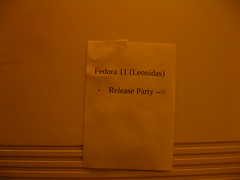
This Saturday (04-July-09) we had a Release Party at Pune. It was fun ! And, the one vein of feedback that we received was “we need to do this more often, and, have regular meetings”. Fine enough, we can see to that. The organizers did a wonderful job of getting the show on the road and, helping wrap things up – a strong start and, a strong finish made it a wonderful experience. We had around 50 people turning up and, with the number of Red Hat folks walk-in, that number would be well over 65. The DVDs were available throughout the meet and, they sure came in handy as folks requested extra media to pass around as well. Towards the end of the meeting, Ramakrishna took off for Bhaskaracharya Pratisthan where around 100 teachers had gathered to talk about curriculum and Open Source and, he ensured that he had enough media to hand around and, notes to show off things.

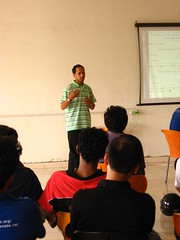
The party is on !Prasad talking about how he got into FOSS development

Photos are available with the tag “Fedora Release Party” The day kicked off with a short welcome address by Rahul Sundaram and, we dived into showing off some videos. Particularly, we got a strong response around the Red Hat Way. It moved into the new items that are in Fedora 11 and, predictably enough, there were plenty of questions around filesystems (ext4) and virtualization (libvirt and KVM). Rahul passed the mic to Rakesh who talked about Package Management, PackageKit, RPM (including a somewhat quick run-down of the RPM internals). It was time for Prasad to step-up and, talk about his projects and how, he got into FOSS and, learnt new languages by devising projects. There were moments of hilarity as the demo instance of pem was using Kushal’s expenses and, we sort of opened up Kushal’s accounts for the participants to ogle at 🙂 Kushal showed off Sugar on a Stick and, talked about Sugar in specific and Sugar-Fedora parts in general. The pizzas (link to image) provided an opportunity to get the interaction going. Especially since there were students in the crowd and, that generally leads to lots of discussions and rapid-fire Q/A.

Post lunch, we had a demonstration by Satish of the work-in-progress Moblin Spin based on Fedora and, a quick introduction to Spins by Rahul. The latter was aimed at taking in feedback about what spins/remixes are worth investing time and effort on and, also an extension to the “what package is missing” survey that he conducted some time back. And, with that it was a wrap. It was wonderful to meet new people. watch the infrequent Fedora T-Shirt in the crowd allowing folks to take note of the communication means (web-page and IRC channels).

There are things we could have done better. Some observations are as:

  • Having a discussion about localization and, internationalization specifically aimed at understanding how content in local language could be produced using Fedora.
  • Quick means to contribution – we barely touched about easy areas to become a contributor
  • Documentation – we should talk more about it
  • Virtualization – with the number of folks interested in questions around v12n, it would have been nice to talk about v12n
  • LiveUSB Creator – we did not anticipate questions around that tool and, there were use cases aplenty. Note to other organizers, never underestimate the power of a sleekly done UI wrapped around a “rock-my-world” tool
  • Project 389 – would have been lovely to have a show-n-tell around this
  • Predicting the footfall – always good to have more folks, but we sure did not anticipate 50+ folks over a weekend. Lesson there about using this momentum to have some form of regular meetings

The post is brought to you by lekhonee v0.6

For the win !

What does it take to be good at something at which failure is so easy,so effortless ? ” : a quote from Better: A Surgeon’s Notes on Performance by Atul Gawande which is a highly recommended reading for those who have not read it yet (that’s a link to the flipkart.com entry for those who are local).

Last evening over dinner, among other things, Runa and me got talking about translations and, translation quality. That is one of our favorite shop-talk items and, since the morning blog had bits about my performance with spellings, it was a bit more significant. It is a somewhat known issue that most translation teams measure the length of the sprint, that is, how many strings were completed or, the percentage of the coverage for a particular project. Some projects attach badges like “supported” / “unsupported“, “main” / “beta” to the coverage and thus make the rush to the tape more important. At some point in time, it is important for the teams to sit down, understand and make notes about the quality of translations. Left to itself, the phrase “quality of translations” doesn’t mean anything does it ? For example, if the phrase was “Disconnect from VPN…” and, you were required to translate it – how wrong can you go ?

It seems you can go wrong, and, most often do.

  • One of the reasons that I have observed is that translating strings in application and, translating content like documentation/release_notes/guides require different kind of mind patterns.
  • The second reason is the lack of fluency in the source language. So, if you are a translator/reviewer for any language, if you are using English source files (as most of us do), you need to be extremely proficient in the language. The way the sentences, phrases and sub-phrases arrange themselves in English may or may not lend themselves to direct translations
  • The third reason is that most translators do not take time out to first use the application in English (or, read the documentation completely in English) and, use it again (or, read it again) after translation. That is a recipe for disaster. English is a funny language and, sometimes, due to the structure of the source files, the context of the content is lost. What does look like a simple word might have a funny implication if the comprehension about how it is placed within the UI or, the user-interaction flow is not made a note of.

Now that most projects have some kind of “localization steering committees” it would be a good small project to observe which locales are coming up with the highest quality of translations and, attempting to understand what they are doing. Asking the language teams about the reasons that inhibit them from maintaining a high quality would also enable deeper understanding of how a project can help itself become a better one (in a somewhat strange loop way). Such discussions would enable coming up with Guidelines for Quality which are important to have. I firmly believe that all developers desire that their applications be consumed by the largest number of audience possible and, at heart, they are willing to sit down and listen to constructive suggestions about how best they can help the localization teams make it happen. That is the sweet spot the “LSCo” folks need to converge on and get going. In fact, for projects like OLPC, where a lot of new paradigms are being created, understanding translation processes and, chipping away at improving translation quality is highly requested.

Translation is still an activity that requires a fanatical attention to detail and, that little bit of ingenuity. There is something not right about committing a translation that smacks of a “letting go of the disciplined focus on detail” and, does not contain anything new. The job is made somewhat more hard when it comes to documentation. One cannot (and, perhaps should not) go beyond what the author has written and yet, it has to be made available in the local language after “stepping into the shoes” (or, “getting into the mind”) of the original author while making it aligned with the natural flow of the target language. This is also the place where the “translator memory”, as opposed to the “Translation Memory” becomes important. The mind should be supple enough to recall how similar idioms were translated earlier or, if an error that was already reported has cropped up again. Translators have a significant bit to contribute towards making the translation source files better, cleaner, well-maintained and, well documented. And, they have to do it right every time.

All this would come together to produce high quality translations and, wider usage of applications and documentation. Collaboration for the win !

The post is brought to you by lekhonee v0.6

Have fun at GUADEC !

I had submitted a talk for the GUADEC which was accepted. However, in light of this blog entry, my decidedly infrequent contributions to GNOME and, an inability to travel using my own finances, I decided that there was no glory in asking for travel+lodging assistance. So, once again, I am not going to be at GUADEC ! Some day I will make it though.

One of the reasons that GCDS was interesting for me was the chance to talk about localization in terms of improving the context of the localization-ready content. During translations, one often encounters sentence construction which does not have context and, providing a means to overcome the issue in a gradual manner would make for much nicer localized UIs. Additionally, learning about improvements to the GNOME L10n infrastructure was a secondary goal. The ulterior motive was also to know about the project’s plans to outreach to groups of students beyond the obvious GSoC and, how to use the project’s knowledge to teach open source.

Meanwhile, let me go back to doing some more translations. They seem to be improving my vocabulary by leaps and bounds. Although, my reviewer says that my spelling is atrocious 😉

The post is brought to you by lekhonee v0.5

Fedora 11 Release Party at Pune on 04-July-2009

This weekend we are organizing a small gathering at Pune for the Fedora faithful. Details about the Release Party are here. Besides getting the Fedora folks to hang out together and share notes, we hope to have some fun, get some show-n-tell going. Photographs and event reports would eventually follow as well.

As an aside, I am posting this using gscribble – a yet another offline client for WordPress blogs being developed by Roshan. I had to rebuild it to get it working for F11 and, the truly bleeding rpms are here

Random bits about community

Of late there has been a significant increase in the number of texts talking about “community”. This could well be a perception bias as well, since I have been looking around trying to see what others are writing or, thinking about groups of people, communes and so forth.

Some of the common aspects of the texts I have stumbled across include attempts to have a model defined, description of a rudimentary framework of tasks, an analysis of infrastructure that facilitates collaboration and, a broad overview of the character of a community. Either way, I am a bit tired about “community” as a word and, I feel that it is beginning to suffer from over-use and under-statement. A primary driver for that feeling is the tendency to look at “communities” as if they were thriving specimens on a petri-dish, isolated and unperturbed in their own imaginative evolutionary cycle. That is simply untenable as a hypothesis and, impossible in real life. Communities are constituted by groups of people and, people react to the push-pull of daily life around them – the political issues, the personal issues and, the social intricacies. As much as communities try, other than a basic tenet that binds them together, there isn’t much difference between the growth of a community and, the evolution of family. The same basic principles of Belief, Responsibility, Accountability and Trust ensure that the forward momentum is not stalled.

The paradox is that having stated the above, I ended up attempting to box-in the “community” into some nice tangible parameters so as to enable explanation. Fun !

The decline of a community or, even a sub-aspect of a community can also be traced to a larger sense of hubris and, a lack of plan in terms of moving forward to embrace change. The hubris part is perhaps derived from moving away from a central core idea that was the genesis of the community and, attaining a false sense of being indestructible to external forces. Statistics are important – but statistics are external representations of symptoms – for example, wiki edits; commits to version control; activity on mailing lists; number of contributors; mass of consumers all these indicate how the community (or, tribe) is moving forward. They do not capture whether the general direction is based on the central core theme and, is moving across a wider spectrum without getting too diluted.

Why can’t “communities” be replaced by “tribes” ? Makes for a better understanding of the complexity of interaction that ensures a sustaining environment for a group of people who perceive a need to exist. And, would be able to come together to arrive at decisions that ensure sustenance. Most communities/tribes are specialized formations of people who find a common space to talk about and extend their areas of interest. As such, the need to “fabricate” a community is somewhat redundant while the need to work on providing a “commons” is important.

ps :The post is rambling in essence, at some point I’d like to re-visit this and, collate the other thoughts.

The post is brought to you by lekhonee v0.4.1

A trail over the weekend

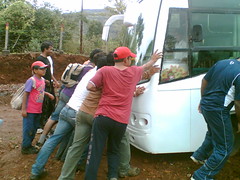
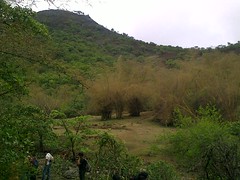
Yesterday a couple of us (well, 11 of us actually) took a trail organized by Trek’Di to the Tamhini Forest. It was something I have not done before and, the completely different nature of sounds within the forest took me by surprise. Some photographs are here. There were elements of fun as well which is bound to happen in a diverse group of folks. The photographs have been from mobile phone cameras mostly, an indication of showers (which were heavy) did not encourage me to take the usual point-n-shoot along

Crowdsourcing at the very best Image(355) Another view of the tree-line

A collection of jottings on various issues that excite no one else